Lolumen Data: what studios get from your shared games
Lolumen Data gives game studios aggregate, anonymous Hearthstone statistics. Here is what they can and can't see, and how your games stay out of it.
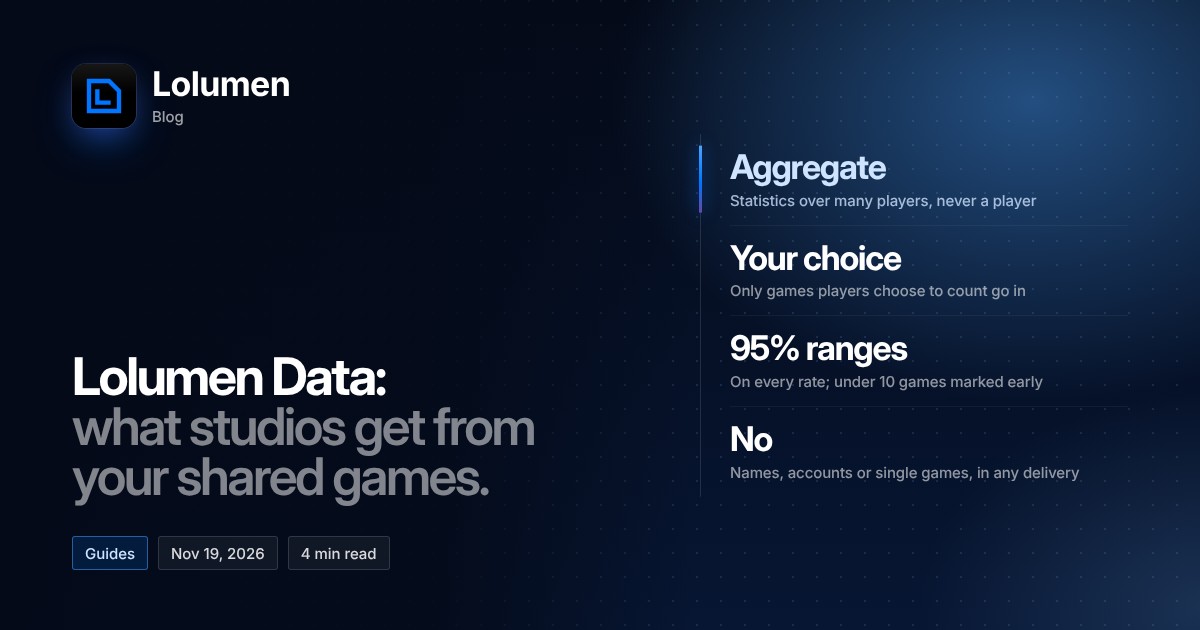
Lolumen has a second audience besides players: game studios. Lolumen Data is the division that gives studios and publishers "aggregate, anonymous insight from the games players track." If you track your Hearthstone games here, you should know what that means for your games, what a studio can and can't see, and how to keep your games out. This guide covers what the Lolumen Data page says, and nothing beyond it.
What it is
The page describes Lolumen Data as "a Lolumen division," and says it is "taking first conversations now." It is not a product with a price list: "Every engagement is scoped first, so there are no packages or prices here." Hearthstone is the only game it covers "in depth today"; other games are listed as ones Lolumen plans to cover.
It offers studios six kinds of work: meta and balance analytics, patch impact, card and deck performance, player experience, feeds and dashboards, and custom studies. These arrive in one of three forms: a report, a dashboard, or a data feed.
What a studio can't see
This part matters most to players. The page is direct about it.
- No player data for sale. Asked "Do you sell player data?", the page answers "No. Lolumen Data provides aggregate statistics and analysis."
- No individuals. "Studios get statistics over many players, never a player: no names, handles, accounts or single games, and no figure small enough to point at one person."
- A fixed list of what is never delivered: names, BattleTags, Riot IDs or accounts; a single game, or a player's history; a figure small enough to point at one person; and games players didn't choose to share.
A studio could learn how an archetype performs across many games at a rank band. It could not find out how you, or any one game of yours, did.
Your games count only if you let them
The page says: "Only games players choose to count go in. Turning that off in Settings takes their games out of every figure from then on." Note the "from then on": by the page's own wording, turning it off affects future figures, not deliveries already made.
The Lolumen Data page doesn't name the setting. Lolumen's privacy docs describe one in Settings → Preferences: "Count my ranked games in the community stats." With it on, your ranked games feed the community class win rates "only as totals, never tied to you." The privacy docs don't mention studios, so check Settings yourself if you want to be sure what you have switched on. Your tracked games, notes and analytics stay private either way: "Nobody else sees them."
How the numbers are built
Lolumen Data uses the same rules as the numbers you see on the Hearthstone meta and in your own analytics:
- Ranges. Every rate comes with its 95% range, "worked out the way Lolumen's own analytics do." Draws are left out.
- Samples. "Anything under 10 decided games is marked early, not called." A thin sample is flagged, not ranked.
- Filters. Every figure states its format, rank band and patch.
- Source. Only games players shared, aggregate and anonymous.
The page shows sample dashboards, a sample report and a sample data feed to illustrate these. They are layout examples. We don't quote their numbers here, because they aren't presented as findings.
Publishers and terms
The page says Lolumen means "to stay within each publisher's published terms" and credits every source. It also says plainly: "No publisher endorses or licenses Lolumen Data." This isn't an official Blizzard data program.
If you work at a studio
The page has a contact form with three kinds of enquiry: commissioning a study, a dashboard or data feed, and a partnership or research. You describe the question, the decision it informs and your timeframe. Lolumen says it uses those details "only to reply to you." Work then runs in four steps: you tell Lolumen the question, it is scoped with you, you sign an agreement, and it is delivered with the updates you agreed.